
How to make a zombie love story AI video
Plan the encounter, the embrace and the warm memory. A practical photo-to-video workflow with a starting prompt and continuity checks.
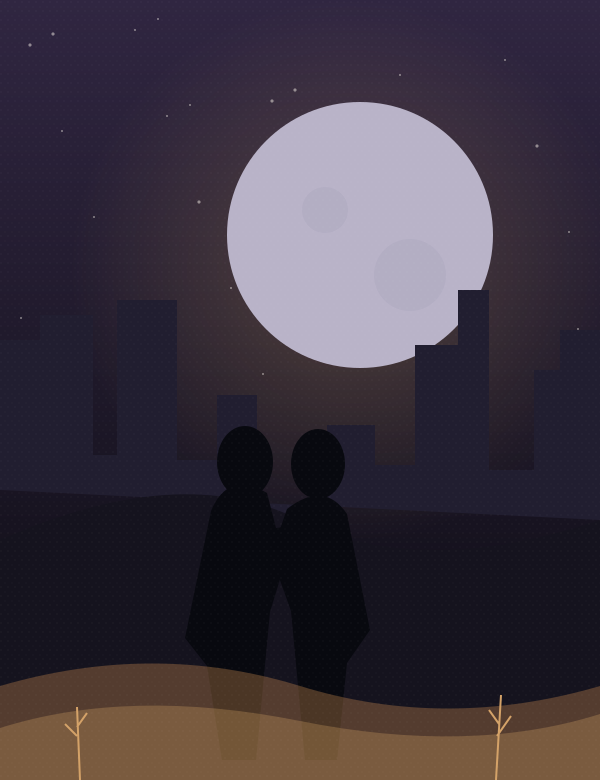
Concept illustration, not a generated video result.
A zombie love story turns a horror setup into a moment of recognition. One person has changed; the other still sees someone they love. A cut from a tense encounter to a warm memory gives the short its emotional payoff.
Availability: this is a planning guide for use in your chosen AI tool. Our zombie love story template is a preview; generation on this website is coming soon. The illustration above is concept artwork, not a test render.
1. Give each person a clear role
Choose one consenting adult to be the survivor and another to be the transformed character. Start with a separate, sharp portrait of each person, with an unobstructed face and even lighting. Give the references distinct labels so you can keep the roles consistent throughout the scene.
Check that your chosen tool supports the reference inputs you need. A tool that accepts only one starting image may need a composed image of the two characters first. Do not assume that uploading two images means it can maintain two identities across multiple shots.
2. Write the emotional turn before the effects
Use three beats rather than asking for a complete movie in one prompt:
- Encounter: establish both people in a quiet, abandoned place. Use a medium shot so the relationship is readable.
- Recognition: the survivor recognizes the other person, relaxes their defensive posture and opens their arms.
- Memory: cut on the embrace to the same pair in a warm, ordinary setting before the transformation.
A lowered weapon appears in some versions of this format, but the story can work without one. Open hands and a hesitant step forward communicate the choice clearly. A non-graphic treatment also keeps the focus on the relationship.
3. Try a small, specific starting prompt
Create a vertical fictional scene with two adult characters from the supplied references. Person A is the survivor. Person B has subtle, non-graphic zombie makeup but remains recognizable. In a cold, quiet street, A recognizes B, relaxes and opens their arms. B approaches slowly. As they embrace, cut directly to the same two healthy people hugging in warm afternoon light. Keep their faces, clothing roles and relative positions consistent. No blood, wounds, text, logos or music.
This is an untested starting prompt, not a guarantee of a specific output. Adapt it to your tool's supported reference format, duration and content rules. If it loses track of the sequence, generate the present and the memory as separate shots instead of adding more instructions to one prompt.
4. Make the cut feel intentional
Choose a similar pose and camera angle for the two embraces. In an editor, cut when the arms meet or when one character moves across the frame. Matching the movement makes the time change easier to follow. You can experiment with a clean cut before trying dissolves or more complex transitions.
Leave time for the memory to register. If the opening consumes the whole clip, shorten the encounter or make the memory a separate shot. The contrast is the point of the story.
5. Review before sharing
- Are the two identities still distinct after the transformation?
- Do the hands and arms connect naturally in the hug?
- Does the warm scene show the same people in the same roles?
- Is the transition understandable without captions?
- Do you have permission for every photo, music recording and other asset you used?
Use an original or appropriately licensed soundtrack, and identify the clip as AI-generated when sharing. Avoid framing a fictional transformation as a real event.
Where to go next
Explore the zombie story concept, try a lighter witch broom scene, or browse the full collection.
For another published approach to the scene, see this zombie love story prompt guide. Model features, pricing and results belong to the provider you choose; this article does not promise equivalent results. For music reuse, the US Copyright Office's musician guide explains the distinction between a composition and a recording.